
The difference between business days and calendar days is simple but easy to get wrong. Calendar days are every day on the calendar, including weekends and holidays. Business days are the days businesses normally operate, which means weekdays only, with weekends and public holidays excluded. So “3 business days” and “3 calendar days” can land on very different dates, and mixing them up is a common cause of missed deadlines.
Contents
TL;DR
- Calendar days count every day. Business days count only weekdays, excluding weekends and public holidays.
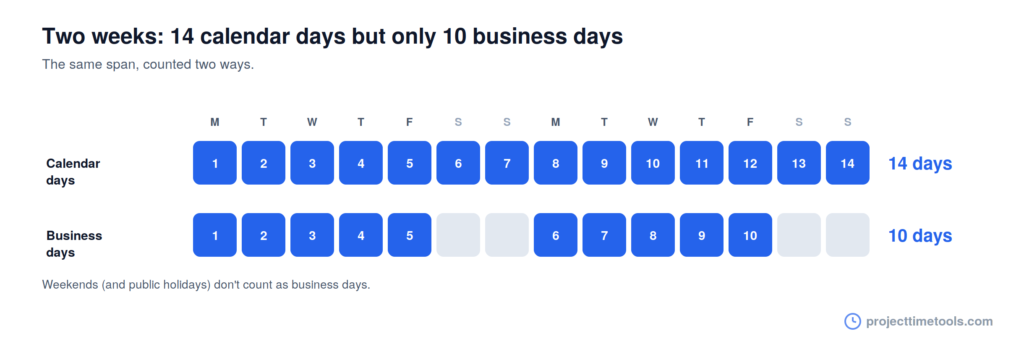
- Two calendar weeks are 14 calendar days but only 10 business days.
- Contracts, shipping, and payments usually run on business days, which is why “5 business days” takes longer than five actual days.
- When a deadline matters, always check which one is meant.
What are calendar days?
A calendar day is any day on the calendar, with no exceptions. Weekends count, public holidays count, every single day is included. If something is due in “10 calendar days,” you count 10 days straight from the start date, regardless of what falls in between.
Calendar days are the simpler of the two to count, which is why they show up in casual use. But they rarely reflect how long real work or business processes actually take.
What are business days?
A business day is a day that businesses normally operate, which in most countries means Monday to Friday. Weekends are excluded, and so are public holidays. Business days are also called working days, and the two terms mean the same thing.
Because they skip weekends and holidays, business days are how most formal timeframes are measured. “Payment within 5 business days” or “delivery in 3 business days” both mean weekdays only. For a fuller explanation, see working days explained.
The key differences
The two answer the same question, “how long until this date,” but count very differently.
| Calendar days | Business days | |
|---|---|---|
| Includes weekends | Yes | No |
| Includes public holidays | Yes | No |
| Days counted | Every day | Weekdays only |
| Used for | Casual timeframes, simple spans | Contracts, shipping, payments, projects |
| Two weeks equals | 14 days | 10 days |
| Easier to count | Yes | No, weekends and holidays complicate it |
Why the difference matters
The gap between the two is bigger than it looks, because it compounds. Every seven calendar days contains only five business days, so the longer the timeframe, the further the two drift apart.
Get them mixed up and real problems follow. Plan a “10-day” task on calendar days when the contract meant 10 business days and you have quietly cut four working days from the schedule. Promise a customer delivery in “5 days” while your courier counts 5 business days and you have set an expectation you will miss. When a date carries any weight, it is worth confirming which type of day is meant.
A worked example
Say something starts on Monday, March 2, 2026, and is due in 10 days.
- Counted as 10 calendar days, it is due on Thursday, March 12 (weekends included).
- Counted as 10 business days, it is due on Monday, March 16, because the two weekends in between do not count. Ten business days is exactly two working weeks, so from a Monday it lands on the Monday two weeks later.
That is a four-day gap on a short timeframe. Stretch it to 30 days and the difference grows to well over a week. The longer the span, the more the choice between business and calendar days changes the answer.
Business days and public holidays
One extra wrinkle: business days also exclude public holidays, and those vary by country and sometimes by region. A date range that contains a public holiday will have one fewer business day in a country that observes it than in one that does not.
This matters most for anything that crosses borders, like international shipping, cross-country teams, or contracts between parties in different places. The same “5 business days” can resolve to different dates depending on whose holidays apply. Counting these by hand gets fiddly fast, which is where a working days calculator saves the guesswork.
FAQs
Calendar days include every day, weekends and holidays included. Business days count only weekdays and exclude weekends and public holidays. So two calendar weeks are 14 calendar days but only 10 business days.
Yes. “Business days” and “working days” mean the same thing: the weekdays a business normally operates, excluding weekends and public holidays.
No. Five business days means five weekdays, so it skips any weekends in between. Starting on a Monday, five business days lands on the following Monday, not the Saturday.
No. Public holidays that fall on a weekday are excluded from business days, just like weekends. A holiday on a weekend was already excluded as a weekend day.
There are 10 business days in two weeks, compared with 14 calendar days, assuming no public holidays fall within the period