
A project milestone is a checkpoint that marks an important moment in a project, such as a sign-off, a delivery, or a launch. Unlike a task, a milestone has no duration: it is a single point in time you either reach or you don’t. Milestones exist to show progress at a glance and to flag when a project is drifting off track.
Contents
TL;DR
- A project milestone is a checkpoint that marks a key moment in a project, like an approval or a launch. It has no duration.
- Milestones are not tasks. A task is work you do; a milestone is a point you reach.
- Set them by marking your major phases, key deliverables, approvals, and the finish line, then giving each a date.
- Keep them few. A handful of meaningful milestones beats a long list nobody tracks.
What is a project milestone?
A project milestone is a fixed point in a project that marks meaningful progress. Think of it as a signpost on the road rather than a stretch of the road itself. Common milestones are things like “requirements approved,” “beta released,” or “project complete.”
The defining trait is that a milestone takes no time. It is the moment a phase ends or a decision is made, not the work leading up to it. That is what separates it from everything else on your plan.
Milestones vs. tasks
This is the distinction people get stuck on, so it is worth being clear.
A task is work that has to be done. It has a duration, a start, and an end. “Design the homepage” is a task.
A milestone is a checkpoint you reach. It has a date but no duration. “Design approved” is a milestone.
A quick way to tell them apart: if you can ask “how long does it take?”, it is a task. If the honest answer is “no time, it either happened or it didn’t,” it is a milestone. Most milestones sit right after an important task or at the end of a phase, marking that the work is done and signed off.
Why milestones matter
Milestones do a few things a task list can’t:
- They show progress fast. Stakeholders don’t want to read every task. They want to know whether you hit “design approved” on time.
- They catch slippage early. If you miss a milestone, everything after it is at risk. A missed milestone is your earliest warning that the end date is moving.
- They break a big project into stages. Reaching a milestone gives the team a clear finish line to aim for, which is easier to plan around than a distant launch date.
Examples of common milestones
Milestones vary by project, but most fall into a few types:
- Project kickoff: the official start.
- Phase completions: “discovery complete,” “development complete.”
- Key deliverables: “first draft delivered,” “beta released.”
- Approvals and sign-offs: “budget approved,” “design signed off.”
- The finish line: launch, handover, or go-live.
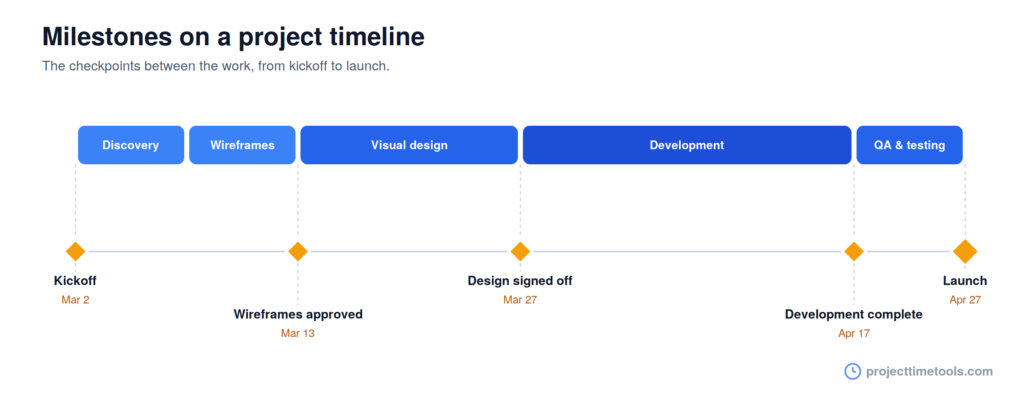
For a small website redesign, the milestone list might be: kickoff, wireframes approved, design signed off, development complete, and launch. Five checkpoints that tell the whole story without listing a single task.
How to set project milestones in 5 steps
1. Map your major phases
Start by breaking the project into stages: discovery, design, build, testing, launch, or whatever fits your work. The end of each phase is a natural milestone.
2. Mark your key deliverables and decisions
Add the moments where something important is handed over or decided. A delivered draft, a chosen direction, a green light to build. These are the points people outside the team actually care about.
3. Add approvals and sign-offs
Approvals are milestones that often get skipped, and they cause the most delays. If work can’t move forward until someone signs off, that sign-off is a milestone worth tracking on its own.
4. Give each milestone a date
Assign a target date to every milestone, working from your timeline. Remember that projects run on working days, so a milestone due “in two weeks” lands on a weekday, not a weekend. The Working Days Calculator helps you land on the right date, and the Project Duration Calculator helps if you’re working forward from a start date.
5. Keep the list short
The most common milestone mistake is having too many. If everything is a milestone, nothing is. Aim for a handful of checkpoints that genuinely mark progress. A month-long project rarely needs more than four or five.
Mistakes to avoid
- Too many milestones. A long list turns into noise. Keep them meaningful.
- Milestones with no owner. Someone should be responsible for each one being reached.
- Confusing them with tasks. A milestone marks that work is done. It is not the work itself.
- Setting dates on calendar days. Count working days, or your milestones will land on weekends.
- Never revisiting them. If a milestone slips, update the ones after it so the plan stays honest.
Milestones are one part of a bigger picture. To see how they fit into the full schedule, read how to create a project timeline, where milestones sit alongside your tasks and dates.
FAQs
A project milestone is a checkpoint that marks a key moment in a project, such as an approval, a delivery, or a launch. It has a date but no duration, so it represents a point you reach rather than work you do.
A task is work with a duration, a start, and an end. A milestone is a checkpoint with a date but no duration. Tasks are the work; milestones mark when important work is finished or a decision is made.
There is no fixed number, but fewer is usually better. A short project may need only four or five milestones. If everything is marked as a milestone, they stop being useful as progress markers.
Common examples include project kickoff, phase completions, key deliverables like a first draft or beta release, approvals and sign-offs, and the final launch or go-live.
No. A milestone is a single point in time. If something takes days or weeks to complete, it is a task or a phase, and the milestone is the moment that work is finished.