
A post-implementation review (PIR) is a structured assessment carried out after a project has been completed and its output is in use. Its purpose is to judge whether the project actually delivered the value it promised: whether it met its objectives, came in on time and budget, produced the expected benefits, and what should be done differently next time. It is how an organisation closes the loop between what a project set out to do and what it truly achieved.
Contents
TL;DR
- A post-implementation review (PIR) is an assessment done after a project is finished, to judge whether it delivered what it set out to.
- It checks three things: did the project meet its objectives, did it deliver the expected benefits, and what can be learned for next time.
- It is not the same as lessons learned. Lessons learned is one part of a PIR, not the whole thing.
- The best time to run one is after the results have had a chance to show, not the day the work ends.
What is a post-implementation review?
A post-implementation review is a formal check, done after a project is delivered, of whether it achieved what it was meant to. It looks back at the original objectives and compares them to the real results, then captures what worked, what did not, and what to carry forward.
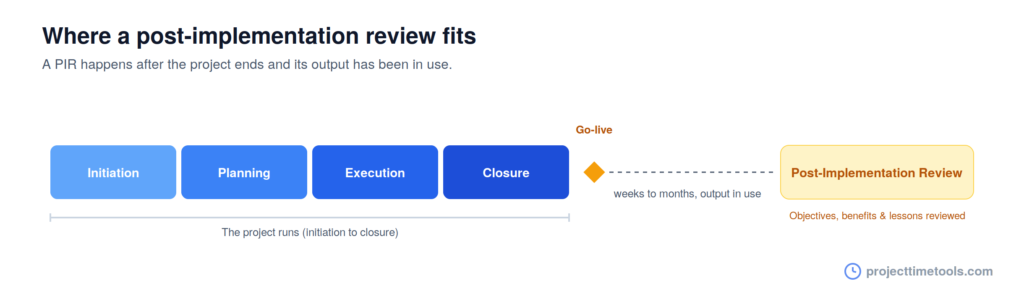
The key word is “implementation.” A PIR happens after the thing has been built and put into use, which is what separates it from reviews done during the project. It is a closure activity, one of the last steps in the project lifecycle.
When does a PIR happen?
A PIR takes place after the project is complete and its output has been live long enough to judge. That timing matters. Run it the day the work ends and you can measure whether it was on time and budget, but not whether it actually delivered value, because the benefits have not had time to appear.
For that reason, many organisations run a PIR a set period after go-live, often a few weeks to a few months, once the results are visible. Some run a light review at handover and a fuller one later.
Why a PIR matters
Without a PIR, a project simply ends, and nobody confirms whether it was worth doing. That gap is common: many organisations struggle to track whether projects delivered their promised benefits at all.
A PIR closes that gap. It holds a project accountable to its original goals, tells stakeholders whether the investment paid off, and turns one project’s experience into better decisions on the next. It is the difference between finishing a project and actually learning from it.
What a PIR covers
A thorough post-implementation review looks at several things:
- Objectives: did the project meet the goals it was set up to achieve?
- Time and budget: was it delivered on schedule and within its planned cost?
- Benefits: are the expected benefits actually being realised now that the output is in use?
- Quality: does the result meet the standard that was expected?
- Process: what went well in how the project was run, and what caused problems?
- Lessons: what should be repeated or avoided on future projects?
PIR vs. lessons learned
These two get confused, so it is worth being clear.
| Lessons learned | Post-implementation review | |
|---|---|---|
| Focus | What the team learned along the way | Whether the whole project delivered value |
| Scope | Process and experience | Objectives, benefits, cost, time, and lessons |
| Timing | Often ongoing or at closure | After the output has been in use |
| Question it answers | “What would we do differently?” | “Did this project achieve what it set out to?” |
Lessons learned is a component of a PIR, not a replacement for it. A PIR captures lessons, but it also judges whether the benefits and objectives were actually met, which lessons learned on its own does not.
How to conduct a post-implementation review
1. Revisit the original objectives
Start with what the project promised: its goals, success criteria, budget, and timeline. This is your yardstick. If there is no clear original plan, the review has nothing to measure against, which is one reason a documented plan matters from the start.
2. Gather the actual results
Collect what really happened: the delivery date, final cost, quality outcomes, and early evidence of benefits. Compare each against the original plan.
3. Get input from the people involved
Talk to the team, sponsors, and the people now using the output. Different perspectives surface things the numbers miss, especially around what worked and what was painful.
4. Identify what worked and what did not
Separate the successes worth repeating from the problems worth avoiding. Be specific and honest; a vague review helps no one.
5. Record lessons and recommendations
Write down clear, reusable lessons and concrete recommendations for future projects, then make sure they are stored somewhere the next team will actually find them.
▶ Planning your next project?
Map it out on a clear timeline before you start, so there is a plan to review against later. Try the free Project Timeline Generator →
Questions to ask in a PIR
A simple set of questions to structure the review:
- Did the project meet its original objectives?
- Was it delivered on time and within budget?
- Are the expected benefits being realised?
- Does the output meet the required quality?
- What went well and should be repeated?
- What went wrong and should be avoided next time?
- What would we do differently on a similar project?
FAQs
A post-implementation review (PIR) is an assessment carried out after a project is finished and in use, to judge whether it met its objectives, delivered the expected benefits, and stayed on time and budget, and to capture lessons for future projects.
After the project is complete and its output has been live long enough for the benefits to show, often a few weeks to a few months after go-live rather than on the final day of the work.
Lessons learned focuses on what the team learned during the project. A post-implementation review is broader: it judges whether the whole project delivered its objectives and benefits, and includes lessons learned as one part.
It is usually led by the project manager or a PMO, with input from the project team, the sponsor, and the people now using what the project delivered.
It should cover whether objectives were met, whether it was on time and budget, whether benefits are being realised, the quality of the result, what went well and badly, and recommendations for future projects.