
How common is remote work now, how are distributed teams actually structured, and does working from home help or hurt output? This article pulls the clearest remote work and distributed-team statistics from authoritative sources, with an eye on the parts that matter most when you are scheduling work across people and places. Every figure is attributed to its source and paraphrased.
Contents
TL;DR
- About 22% of US workers do at least some work remotely, a rate that has held steady since late 2022 (BLS).
- Hybrid is the dominant model: among remote-capable jobs, roughly half are hybrid and about a quarter fully remote (Gallup).
- Most distributed teams now span time zones: 74% of workers say their company operates across multiple ones (Buffer).
- A landmark Stanford trial found hybrid work cut quit rates by a third with no hit to performance (Nature).
How many people work remotely
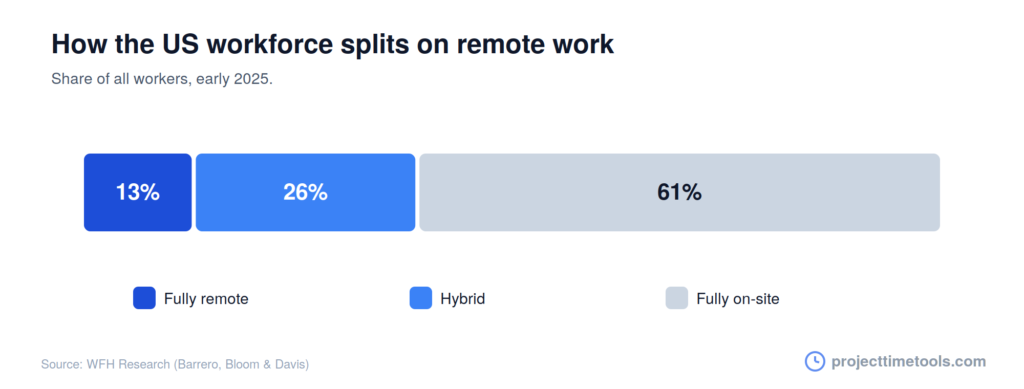
- Across the whole US workforce, the split is around 13% fully remote, 26% hybrid, and 61% fully on-site, with figures varying a little between surveys (WFH Research).
- About 22% of US workers teleworked on average in 2025, a rate that has held between roughly 18% and 24% since late 2022, so remote work has settled rather than collapsed (BLS Current Population Survey).
- Among jobs that can be done remotely, hybrid dominates: roughly half are hybrid, about a quarter fully remote, and the rest fully on-site (Gallup).
- Roughly half of all US full-time jobs are remote-capable, though whether the flexibility is offered depends on employer and industry (Gallup).
- Hybrid is global in scale: around 100 million employees across Europe and North America work on a hybrid basis (Nature, 2024).
What workers actually want
- In Buffer’s survey, 98% of remote workers said they want to work remotely at least some of the time for the rest of their careers (Buffer).
- About six in ten remote-capable employees say they want a hybrid arrangement, and the large majority want at least some remote flexibility (Gallup).
- Workers value that flexibility highly: research puts the worth of hybrid work at roughly the equivalent of an 8% pay raise (Stanford, 2024).
Distributed teams and time zones
This is where remote work meets scheduling, and where it gets hard.
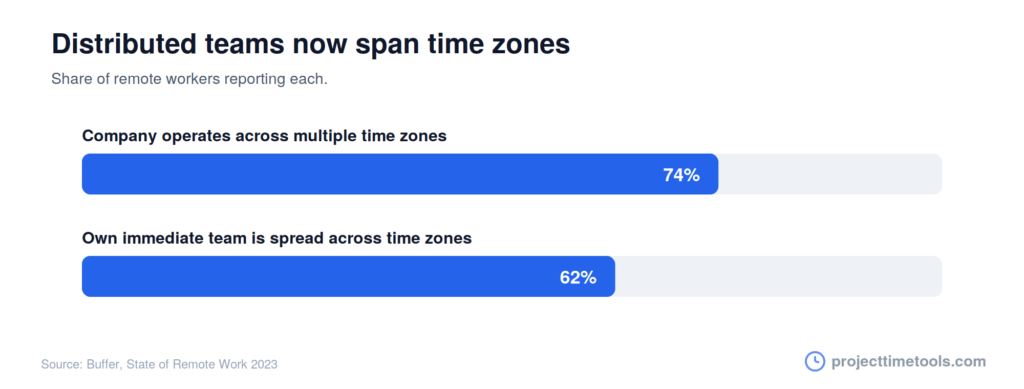
- 74% of workers say their company operates across multiple time zones, and 62% say their own immediate team is spread across them (Buffer).
- Working across time zones is a top-named struggle, cited by roughly one in five remote workers (Buffer).
- Meetings still eat into the week: about 52% of remote workers spend one to five hours a week in meetings, and 23% spend six to ten (Buffer).
Time zones are the one struggle better software does not fix. It is a scheduling problem, solved with rules rather than tools: agree a few core overlap hours for live calls and treat everything else as asynchronous. When your team spans countries, remember that working days and public holidays differ by location too, which is worth accounting for in any shared deadline (see working days explained).
The biggest remote-work struggles
When Buffer asked remote workers what they struggle with most, the answers were about people and boundaries, not technology:
- Staying home too much and lacking a reason to leave (the single most-cited struggle).
- Loneliness (around 23%).
- Not being able to unplug (around 22%).
- Working across time zones (around 19%).
- Collaboration and communication (around 15%), notably a challenge that has fallen year on year as teams settle into remote norms.
Structure matters too: a Microsoft study of over 61,000 employees found that shifting to full remote work made teams more siloed, with less communication across groups and fewer real-time conversations (Microsoft, Nature Human Behaviour 2021).
Does remote work hurt productivity?
The most rigorous evidence says no, and it is worth knowing well because it is the stat people argue about most.
- In a randomized controlled trial of 1,612 employees at travel company Trip.com, giving staff two work-from-home days a week cut quit rates by about a third while having no measurable effect on performance reviews, promotions, or output (Nature, 2024).
- The retention gains were largest for non-managers, women, and employees with long commutes (Nature, 2024).
- Notably, managers predicted productivity would fall, then changed their minds once the trial ran, and the company rolled hybrid out company-wide afterward (Stanford, 2024).
The practical read: hybrid did not cost output, and it sharply reduced the expense of people quitting. The catch from the same research is that it works best when teams coordinate which days everyone is in, which is a scheduling problem, not a location one.
Remote work by industry
Remote work is concentrated where the work is information-based. In the BLS Business Response Survey, the industries with the highest share of establishments employing teleworkers were (BLS):
- Information (technology and media) at around 67%.
- Professional and business services at around 49%.
- Educational services at around 46%, and wholesale trade at around 39%.
- Hands-on sectors like construction, agriculture, and food service sit far lower, in the low single digits.
Sources
- BLS (US Bureau of Labor Statistics): telework by status, CPS 2025 annual averages and telework by industry, Business Response Survey.
- Gallup: Global Indicator: Hybrid Work, remote-capable splits and preferences.
- WFH Research (Barrero, Bloom and Davis): wfhresearch.com, US remote and hybrid trends.
- Buffer: State of Remote Work 2023, distributed teams, time zones, and struggles.
- Bloom, Han and Liang: “Hybrid working from home improves retention without damaging performance,” Nature, 2024, and Stanford SIEPR summary.
- Microsoft: “The Effects of Remote Work on Collaboration Among Information Workers,” Nature Human Behaviour.
FAQs
Around 22% of US workers work remotely at least part of the time, a rate that has held between roughly 18% and 24% since late 2022 (BLS). Among jobs that can be done remotely, about half are hybrid and a quarter fully remote (WFH Research).
The strongest evidence, a randomized trial of over 1,600 employees, found that two work-from-home days a week had no measurable effect on performance while cutting quit rates by about a third (Bloom, Nature 2024).
Remote workers most often name people-and-boundary struggles: too much time at home, loneliness, not unplugging, and working across time zones, rather than technical problems (Buffer).
Very common. 74% of workers say their company operates across multiple time zones, and 62% say their own immediate team is spread across them (Buffer).
Technology leads by a wide margin, followed by consulting and finance. Hands-on sectors like construction and food service have very little remote work (Statista, Gallup).